Best uses
- Translate base-8 values into ordinary decimal numbers.
- Check programming or file-permission examples.
- Practice positional number systems.
Convert octal numbers to decimal online using powers of 8, with step-by-step examples, invalid digit checks, FAQs, and conversion tips.
To convert octal to decimal, multiply each octal digit by the matching power of 8, then add the results together. The rightmost whole-number digit uses 80, the next uses 81, and so on: Convert each octal digit to its decimal equivalent and multiply it by the corresponding positional value. Sum up these products to obtain the decimal equivalent of the entire octal number. This method provides a clear step-by-step approach for manual conversion, allowing for a better understanding of the positional values associated with each octal digit.
For each octal digit d, n is the position of that digit:
dn-1 .... d4 d3 d3 d2 d1 d0 . d-1 d-2 d-3
The decimal number is equal to the sum of octal digits (dn) times their power of (8n):
decimal = dn-1 x 8n-1 + .... + d1 x 81 + d0 x 80 + d-1 x 8-1 + .... + d-n x 8-n
Convert (57.62)8 to decimal.
| octal number: | 5 | 7 | . | 6 | 2 |
|---|---|---|---|---|---|
| power of 8: | 81 | 80 | 8-1 | 8-2 |
(57.62)8= (?) 10
= 5 x 81 + 7 x 80 + 6 x 8-1 + 2 x 8-2
= 40 + 7 + 0.75 + 0.03125
= (47.78125)10
| Octal | Decimal |
|---|---|
| 0 | 0 |
| 1 | 1 |
| 2 | 2 |
| 3 | 3 |
| 4 | 4 |
| 5 | 5 |
| 6 | 6 |
| 7 | 7 |
| 10 | 8 |
| 11 | 9 |
| 12 | 10 |
| 13 | 11 |
| 14 | 12 |
| 15 | 13 |
| 16 | 14 |
| 17 | 15 |
| 20 | 16 |
| 21 | 17 |
| 22 | 18 |
| 23 | 19 |
| 24 | 20 |
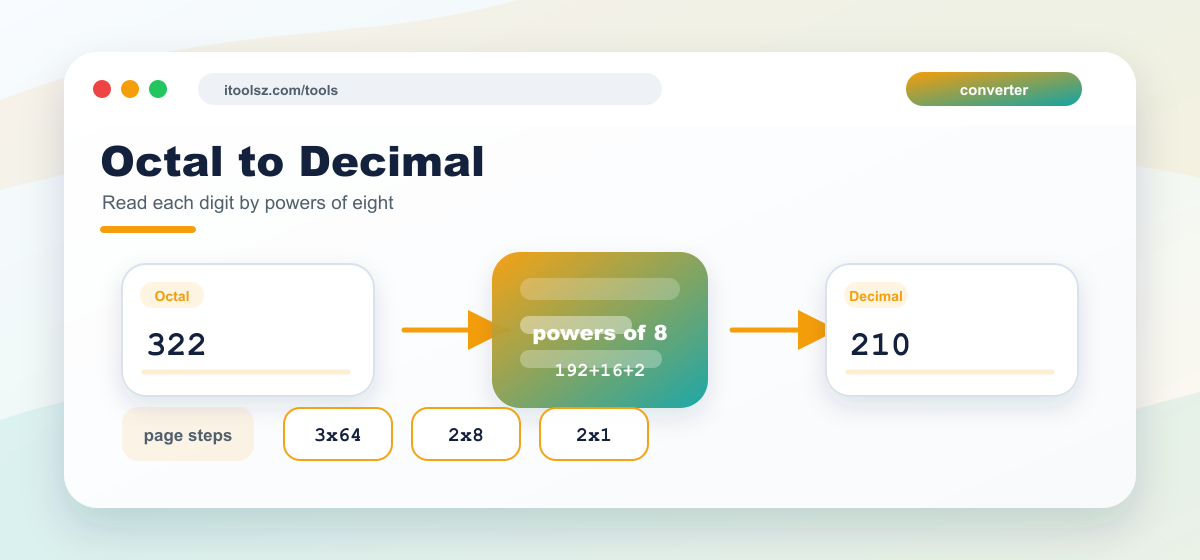
Octal to decimal conversion uses powers of 8. Multiply each octal digit by the matching power of 8, then add the results.
322 in octal equals 210 in decimal because it is 3x64 + 2x8 + 2.
Any base raised to the power 0 equals 1, so the rightmost whole-number place is 8^0.