Best uses
- Make long binary values easier to read.
- Work with colors, memory addresses, masks, and programming examples.
- Check base-2 to base-16 homework.
Convert binary numbers to hexadecimal online, learn 4-bit grouping, and check examples, conversion steps, FAQs, and common errors.
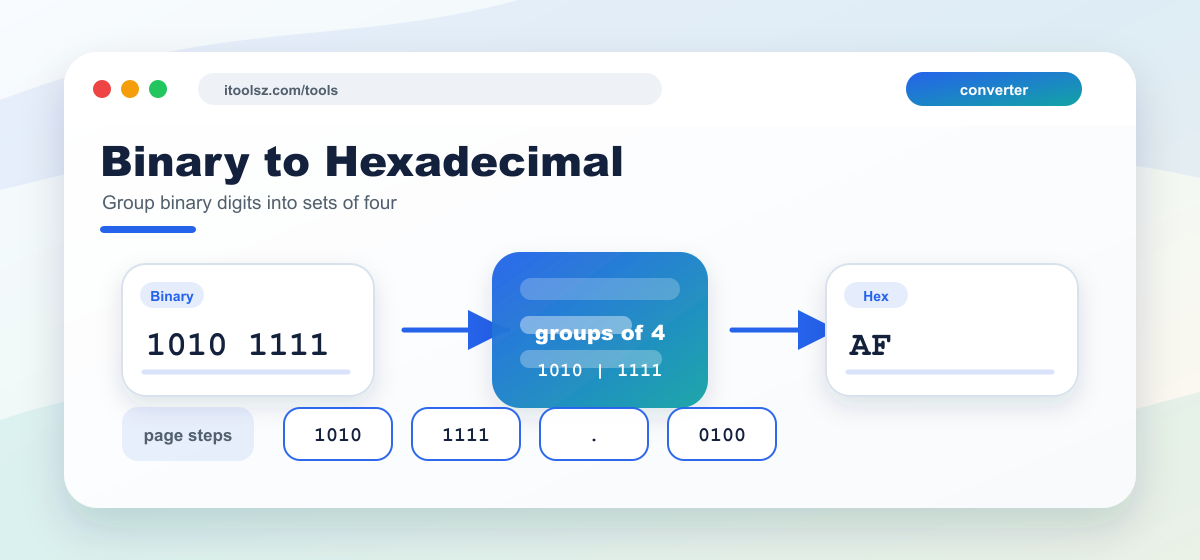
To convert binary to hexadecimal, group the binary digits into sets of four, convert each group to its hexadecimal value, and combine the results. This works because 24 = 16, so one hexadecimal digit maps to four binary digits.
Convert (1111010.1001111)2 to hexadecimal.
| Binary= | 1 0 1 0 | 0 1 1 1 | . | 1 0 0 1 | 1 1 1 0 |
|---|---|---|---|---|---|
| Chunk= | ________ | ________ | . | ________ | ________ |
| Arrows= | ↓ | ↓ | ↓ | ↓ | |
| Hexadecimal= | A | 7 | . | 9 | E |
Note: Use groups of four binary digits. Add leading zeros to the left of the whole-number part or trailing zeros to the right of the fractional part when a group is incomplete.
Hexadecimal is a compact way to display binary data. Developers use it in memory addresses, color values, byte sequences, network examples, and debugging output because four binary digits can be written as one hexadecimal digit. This converter is useful when you want the shorter form but still need to understand the bit grouping.
| Binary | Hexadecimal |
|---|---|
| 0 | 0 |
| 1 | 1 |
| 10 | 2 |
| 11 | 3 |
| 100 | 4 |
| 101 | 5 |
| 110 | 6 |
| 111 | 7 |
| 1000 | 8 |
| 1001 | 9 |
| 1010 | A |
| 1011 | B |
| 1100 | C |
| 1101 | D |
| 1110 | E |
| 1111 | F |
Binary to hexadecimal conversion uses groups of four bits. Each 4-bit group becomes one hex digit, using 0 to 9 and A to F.
1111 in binary equals 15 in decimal, and 15 is written as F in hexadecimal.
Yes. One hex digit represents four binary bits, so hex is much more compact.