Best uses
- Expand octal values into binary for study or debugging.
- Check permission-style octal values at the bit level.
- Practice base-8 to base-2 conversion.
Convert octal numbers to binary online by mapping each octal digit to three bits, with examples, checks, FAQs, and common mistakes.
Converting an octal number to binary involves a systematic process where each digit in the octal number is replaced with its corresponding binary representation. In octal, each digit represents a power of 8, and in binary, each digit represents a power of 2. To perform the conversion, a table is utilized, mapping each octal digit to its binary equivalent. Starting from the leftmost digit of the octal number, each digit is substituted with its binary counterpart, ensuring that the binary representation is three bits long by adding leading zeros if needed. The binary representations of individual octal digits are then combined to yield the binary equivalent of the entire octal number. The final result may be further refined by removing any leading zeros. This method offers a step-by-step approach to manually convert octal numbers to binary, providing a clear understanding of the positional values and binary representations associated with each octal digit.
To convert octal to binary, replace each octal digit with its 3-bit binary equivalent. This works because
23 = 8. That means each octal digit can be written as a group of three binary digits.
Note: Leading zeros can be removed from the final binary result when they are not needed.
(217.102)8 = (?)2
| Octal= | 2 | 1 | 7 | . | 1 | 0 | 2 |
|---|---|---|---|---|---|---|---|
| Arrow= | ↓ | ↓ | ↓ | . | ↓ | ↓ | ↓ |
| Chunk= | ______ | ______ | ______ | . | ______ | ______ | ______ |
| Binary= | 0 1 0 | 0 0 1 | 1 1 1 | . | 0 0 1 | 0 0 0 | 0 1 0 |
| Octal | Binary |
|---|---|
| 0 | 000 |
| 1 | 001 |
| 2 | 010 |
| 3 | 011 |
| 4 | 100 |
| 5 | 101 |
| 6 | 110 |
| 7 | 111 |
| 10 | 001000 |
| 11 | 001001 |
| 12 | 001010 |
| 13 | 001011 |
| 14 | 001100 |
| 15 | 001101 |
Map each octal digit independently: 0 becomes 000, 1 becomes 001, and the pattern continues through 7 becoming 111. Keep leading zeros inside every three-bit group while joining the groups. After the full number is assembled, zeros at the far left of the whole part may be removed, but deleting a zero inside the result changes later bit positions.
The same mapping works on both sides of an octal point. Start again immediately after the point and write three binary digits for every fractional octal digit. This method is exact because one octal digit always represents three bits; it does not require decimal rounding. Convert the binary groups back to octal to verify a copied or handwritten result.
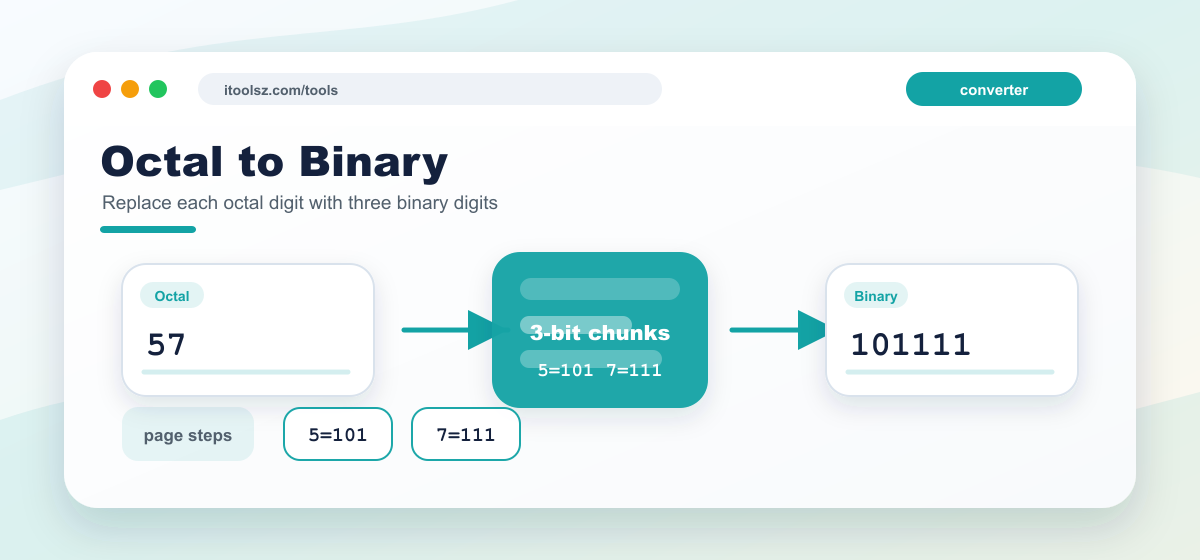
Octal to binary conversion is direct because each octal digit maps to exactly three binary bits. Replace every octal digit with its 3-bit equivalent.
Three binary bits can represent values from 0 to 7, the full octal digit range.
Yes. 5 maps to 101 and 7 maps to 111, so 57 becomes 101111.